

 Site Navigation

The Dyslexia Action Postgraduate qualifications are Level 7 programmes developed by our experts at Dyslexia Action. They are awarded and quality assured by Middlesex University.
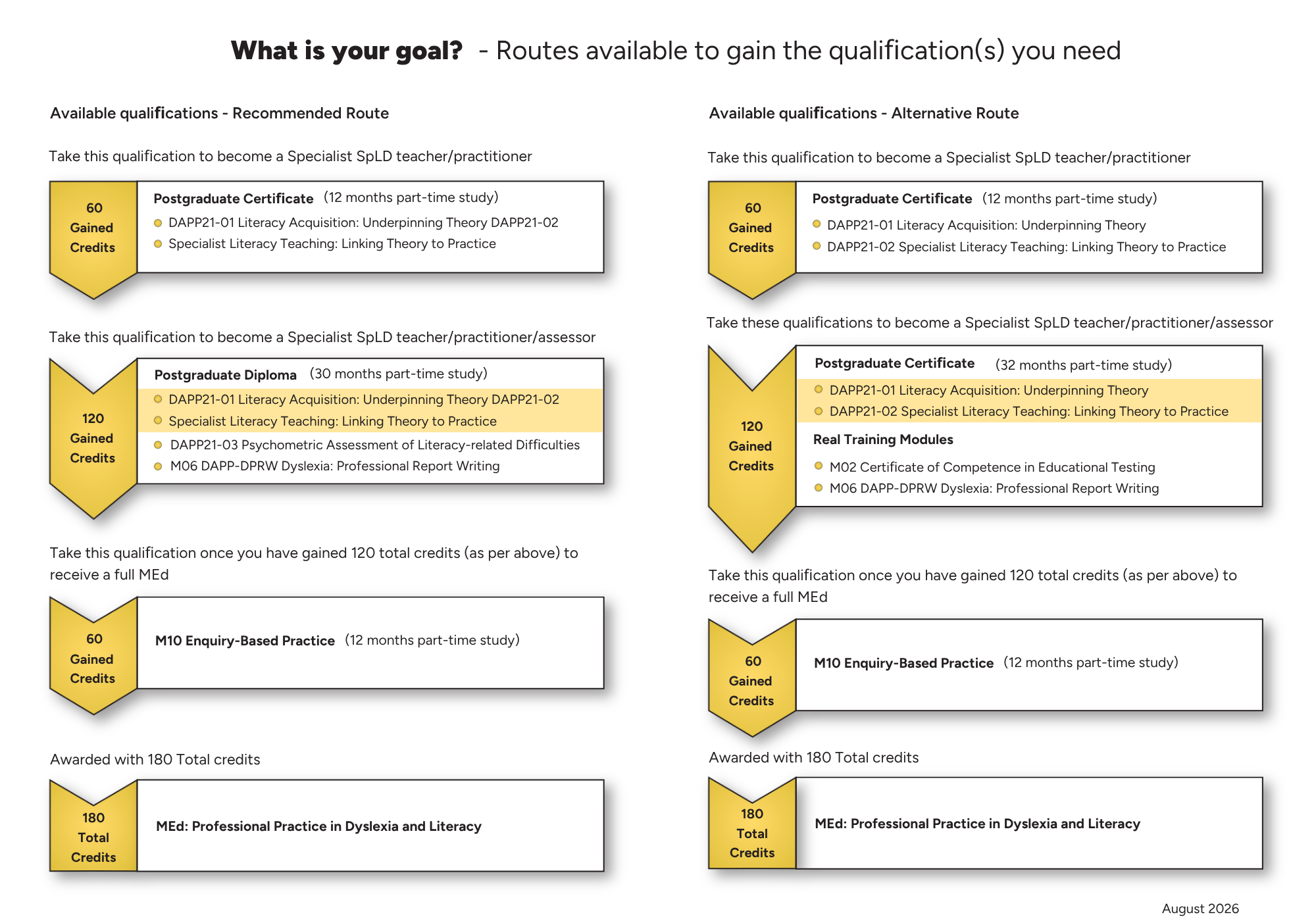
Our PGCert qualifies you to practice as a specialist SpLD teacher/practitioner; while the PGDip and MEd qualifies you as an SpLD assessor, eligible to apply for an Assessment Practising Certificate (APC) through The Dyslexia Guild, a SASC-approved awarding body.
An APC is required to be able to carry out formal diagnostic assessments of dyslexia and write reports accepted for DSA (disabled students allowance).
Courses are accessible 24/7 via our Virtual Learning Environment (VLE) and all modules are tutor-supported through online forums.
If you do not hold a degree then please see our Level 5 CPD Pathway SpLD Teacher/Practitioner Route.

The Dyslexia Action Postgraduate Certificate in literacy-related difficulties is appropriate for a wide range of teachers, practitioners and specialists who have a relevant classroom or student learning support experience including:
QUALIFICATIONS
Prospective students will have:
Private tutors:
Private tutoring will partly count as recent and relevant experience and if you hold QTS/PGCE this will strengthen your application. You will need:
If you do not have any recent or substantial experience of working in school/college, you will need to show that you have found a placement for the teaching practice DAPP21-02 BEFORE you apply
Applicants who do not fulfil all the requirements above may be considered for ‘special entry’ if they can demonstrate other relevant academic and professional experience. Such applicants are advised to apply in the first instance and fully explain their experience in their application statement.
Please note: We reserve the right to reject any application that does not meet the criteria specified.
In order to achieve this qualification, you will have to complete the following modules:
View our dyslexia postgraduate programme syllabus for more information.
In order to achieve this qualification, you have the choice of two different training pathways:
Option one:
Option two:
View our dyslexia postgraduate programme syllabus for more information.
To gain the full MEd Professional Practice in Dyslexia and Literacy, you must complete 180 credits at Level 7 (Master’s Level). There are two routes available.
View our dyslexia postgraduate programme syllabus for more information.
Practitioners who hold a Level 5 SpLD Teaching Qualification may be eligible to progress directly to the assessment modules. This route leads to eligibility for an Assessment Practising Certificate (APC) through The Dyslexia Guild. Practitioners who hold a Level 7 SpLD Teaching Qualification and wish to add assessment competence should contact Dyslexia Action to discuss the appropriate entry point.
View option 2 on our dedicated page about how to become a dyslexia assessor.
This programme was developed and is delivered and assessed by Dyslexia Action, awarded by and quality assured by Middlesex University. The Postgraduate Certificate and Diploma programmes are also recognised by several professional SpLD membership bodies for accredited specialist teacher/practitioner/assessor status.
Candidates will automatically become student members of The Dyslexia Guild for the first year of their course while they are actively studying on a Level 7 Postgraduate Certificate: Specialist Teaching or Postgraduate Diploma: Specialist Assessment and Teaching Programme with Dyslexia Action. The Guild is a membership network and professional association for practitioners in Dyslexia and SpLD, which aims to promote discussion, information and best practice as well as keep members informed of developments in the field through publication and distribution of topical news, updates and maintenance of an up-to-date library.
The Guild provides its members with a wealth of information relating to dyslexia and SpLDs through its online library (the National Resource Centre for Dyslexia), a single-easy to access online platform that produces focused search results accessible by members 24/7. The library is supported by a Chartered Librarian and provides a unique, e-resource collection, covering the fields of dyslexia and other co-occurring difficulties. Participants have access to an online collection of over 800 specialist e-books, hard copy books and resources as well as simultaneous access to an online EBSCO database of over 1,600 full-text education and psychology journals.
Cost*: Apply for the programme, once accepted Module fees (payable in four instalments) are as follows:
DAPP21-01: £2,265 +VAT
DAPP21-02: £2,395 +VAT
There are no additional costs for International delegates.
For further information please visit our payment FAQ page
*Individual module prices may be subject to an annual increase on 1 October
Please note: professional practice assessment test costs may also apply.
There are no additional costs for International delegates.
For further information please visit our payment FAQ page
*Individual module prices may be subject to an annual increase on 1 October
For further information please visit our payment FAQ page
Interested in applying? Please ensure you have read the syllabus document above and complete an application through the ‘How to Apply’ section.
If you have any further queries please contact trainingcourses@dyslexiaaction.org.uk
Participants currently studying with us on the Level 7 Postgraduate programme should direct enquiries to pgmail@dyslexiaaction.org.uk
AMBDA is a professional membership level held with the British Dyslexia Association – it is not equivalent to an APC (assessment practising certificate). Its closest equivalent is recognition by The Dyslexia Guild with MDG status.
Completing Dyslexia Action’s postgraduate diploma or MEd means you are eligible to apply for either MDG or AMBDA status. In either situation, it is strongly recommended that you also hold an APC. Since 2019, diagnostic reports written by APC holders can be used for Disabled Students’ Allowances (DSA) indefinitely, meaning that a dyslexia diagnosis stays valid throughout a person’s lifetime.
The following organisations are SpLD membership bodies and approved awarding organisations of APCs;
How do MDG and AMBDA compare?
Both AMBDA and MDG status have comparable membership fees and offer benefits such as;
However, there are several unique benefits of choosing to gain your professional membership through The Dyslexia Guild including,