
 Site Navigation
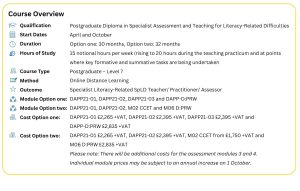
This Level 7 teacher/practitioner-assessor diploma provides a thorough theoretical foundation in dyslexia and literacy research while fostering critical thinking, reflective practice, and disciplined postgraduate enquiry. Designed to develop enlightened educators, the programme will equip you with the specialist subject knowledge needed to appraise, plan, and deliver tailored intervention programmes for your students who experience literacy-related difficulties. Additionally, it will strengthen your ability to effectively communicate this specialist expertise to both specialist and non-specialist audiences across a range of settings. You will also gain a thorough theoretical grounding in the psychometric assessment of cognitive processes that underlie literacy-related difficulties.
The programme is modular and flexible and is undertaken part-time, through online learning. Access is available 24/7 to Campus Online, our Virtual Learning Environment and all modules are tutor-supported through online forums.
This programme is delivered and assessed by Dyslexia Action, awarded by and quality assured by Middlesex University.
If you do not hold a degree then please see our Level 5 CPD Pathway SpLD Teacher/Practitioner Route.

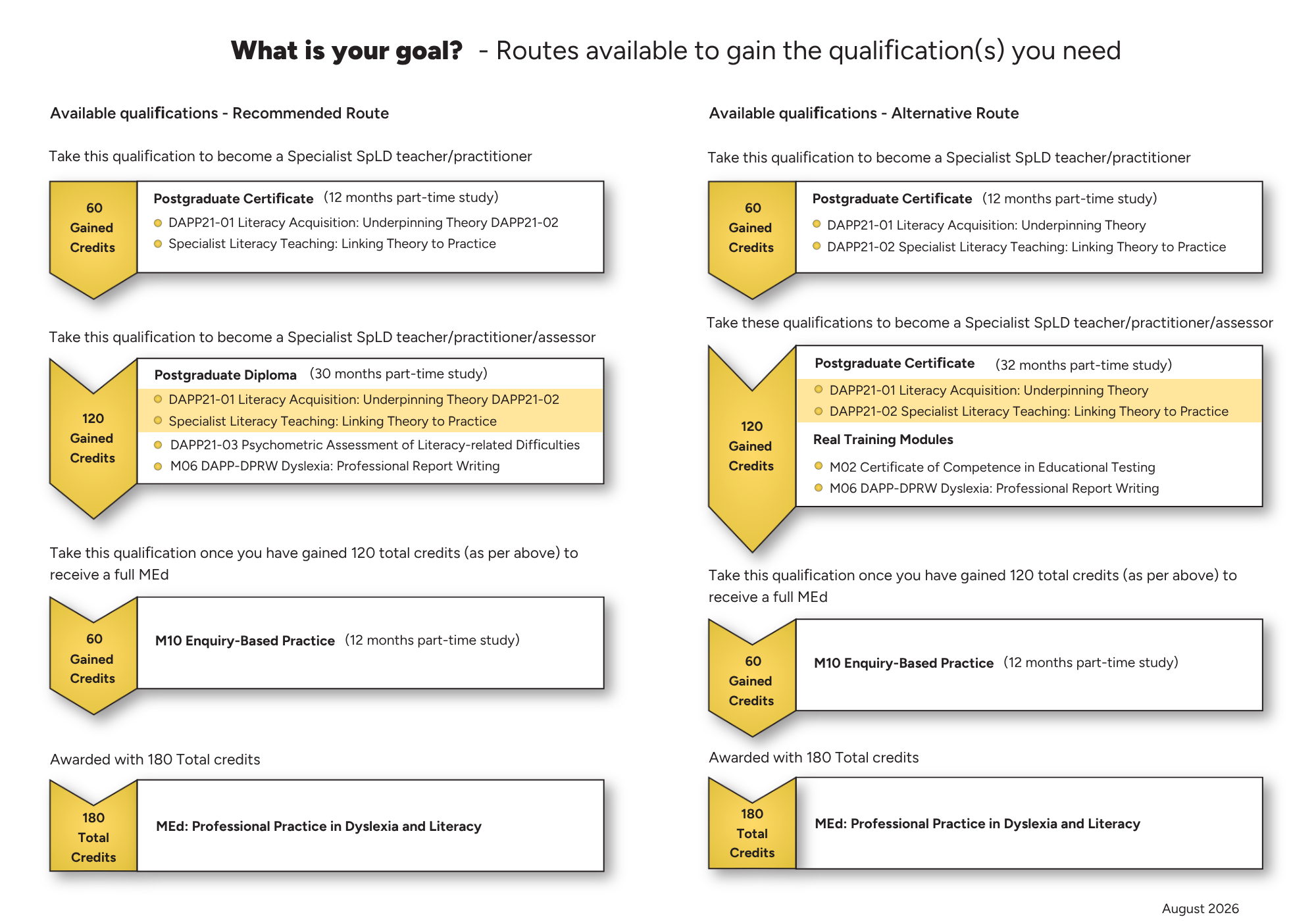
There are two routes available in order to achieve this qualification (for full module information please click on the links below):
Option one (standard route) – Dyslexia Action (30 months)
Option two (alternative route) – Dyslexia Action and Real Training (30-32 months)
If you already hold an eligible level 5 or 7 SpLD teacher/practitioner qualification, or Real Training’s CCET or CPT3A you might be interested in this route. Please contact trainingcourses@dyslexiaaction.org.uk if you require further discussion.
This Postgraduate Diploma in literacy-related difficulties is appropriate for a wide range of teachers, practitioners and specialists who have a relevant classroom or student learning support experience including:
QUALIFICATIONS
Prospective students will have:
Private tutors:
Private tutoring will partly count as recent and relevant experience and if you hold QTS/PGCE this will strengthen your application. You will need:
If you do not have any recent or substantial experience of working in school/college, you will need to show that you have found a placement for the teaching practice DAPP21-02 BEFORE you apply
Applicants who do not fulfil all the requirements above may be considered for ‘special entry’ if they can demonstrate other relevant academic and professional experience. Such applicants are advised to apply in the first instance and fully explain their experience in their application statement.
Please note: We reserve the right to reject any application that does not meet the criteria specified.
Are there any live sessions?
There are no ‘live’ lecturers, one-to-one tutorials or meeting provisions within the modules or requirements to be online at particular/set times of the day. The exception to this is if you decide to follow route 2 and opt for the intensive delivery method for the CCET course.
Working with a learner
You will be required to find learners whose main difficulties are with literacy and who are not currently receiving any other form of specialist teaching support. You can only teach a learner within a DfE registered state or independent school/college with a Unique Reference Number (URN). See: get-information-schools to find school and college URNs (this does not apply to those based overseas, although the school/college should be a registered organisation through the state authority). This can be a voluntary placement and you must be covered by the organisation’s DBS.
See: Module outlines above and the programme syllabus for further details.
After completion of the Postgraduate Diploma Specialist Assessment and Teaching for Literacy-Related Difficulties (option one or two) you will become a fully qualified Assessor which gives you eligibility to apply for an Assessment Practising Certificate (APC). You may also be interested in completing the Enquiry-Based Practice Module (M10 – 60 credits) with our sister company Real Training to gain the Masters in Professional Practice in Dyslexia and Literacy.
See: Programme syllabus for further details.
The Dyslexia Action Postgraduate programme is a competency-assessed course at Level 7, Master’s level, which requires tutor assessment of the candidate undertaking teaching and assessment. This means that other academic programmes that have not included competency assessment or are at a lower level (e.g. Level 5 or Level 6) will not qualify for recognition of prior learning (RPL).
For further details see: Recognition of Prior Learning
Cost*: Apply for the programme, once accepted Module fees (payable in four instalments) are as follows.
Option one:
DAPP21-01: £2,265 +VAT
DAPP21-02: £2,395 +VAT
DAPP21-03: £2,395 +VAT
DAPP-DPRW: £2,835 +VAT
Please note: professional practice assessment test costs may also apply for modules 3 and 4.
Option two:
DAPP21-01: £2,265 +VAT
DAPP21-02: £2,395 +VAT
M02 CCET: from £1,750 +VAT
M06 DAPP-DPRW: £2,835 +VAT
Please note: professional practice assessment test costs may also apply for M02 and M06.
There are no additional costs for International delegates.
For further information please visit our payment FAQ page
*Individual module prices may be subject to an annual increase on 1 October
6 April 2027 cohort – apply by 4 March 2027
We reserve the right to close applications early if the cohorts are full.

Application Review
Your application will be reviewed by the:
Next Steps (Decision)
A decision on the outcome of your application usually takes up to 10 working days.
Professional Practice Materials
Applicants should note that the Dyslexia Action Postgraduate Diploma qualification is intended for individuals who wish to work as specialist literacy teachers/practitioners-assessors. You will need personal copies of your own test materials and you will then be able to use these for your own professional practice following the course.
See: Module overviews for test requirements
You will be sent a full list of required resources including assessment tests, practical teaching materials, books and materials once you have registered for the course.
Dyslexia Action courses have been in existence for 50 years and have a national respected profile in specialist teacher training and support. Our courses meet several accreditation criteria reflecting the importance we place on the quality of our courses and high standards of teaching and learning which are intrinsic to our programmes.
The Postgraduate Diploma in Specialist Assessment and Teaching for Literacy-Related Difficulties confers eligibility for Member of The Dyslexia Guild (MDG) recognised as the first grade of professional membership for a specialist teacher/practitioner-assessor. Other membership bodies include the British Dyslexia Association for Associate Member of the British Dyslexia Association – AMBDA and PATOSS for Full membership.
Free membership of The Dyslexia Guild
Delegates will automatically become student members of The Dyslexia Guild for the first year of their course while they are actively studying on a Postgraduate Certificate in Specialist Teaching, or Postgraduate Diploma in Specialist Assessment and Teaching Programme with Dyslexia Action. The Guild is a membership network and professional association for practitioners in Dyslexia and SpLD, which aims to promote discussion, information and best practice as well as keep members informed of developments in the field through publication and distribution of topical news, updates and maintenance of an up-to-date library.
The Guild provides its members with a wealth of information relating to dyslexia and SpLDs through its online library (the National Resource Centre for Dyslexia), a single-easy to access online platform that produces focused search results accessible by members 24/7. The library is supported by a Chartered Librarian and provides a unique, e-resource collection, covering the fields of dyslexia and other co-occurring difficulties. Participants have access to an online collection of over 800 specialist e-books, hard copy books and resources as well as simultaneous access to an online EBSCO database of over 1,600 full-text education and psychology journals.
What is an Assessment Practising Certificate (APC)?
The Department for Education (DfE) requires that specialist teachers or support tutors who undertake specialist assessments in post-16 schools, colleges, universities, workplace training establishments and local authority assessment centres are competent and qualified to do so.
An APC is effectively a licence to practise. It confirms that you have the appropriate qualifications to undertake full dyslexia assessments and that your professional practice is up-to-date and has been externally verified as continuing to meet defined competence standards.
The Dyslexia Guild is an APC awarding body issuing Assessment Practising Certificates on behalf of the SpLD Assessment Standards Committee (SASC).
Either of the above two training options are eligible for an application of an APC. For further details click here
01784 222 304
Complete the online booking form to
enrol on one of our training courses