


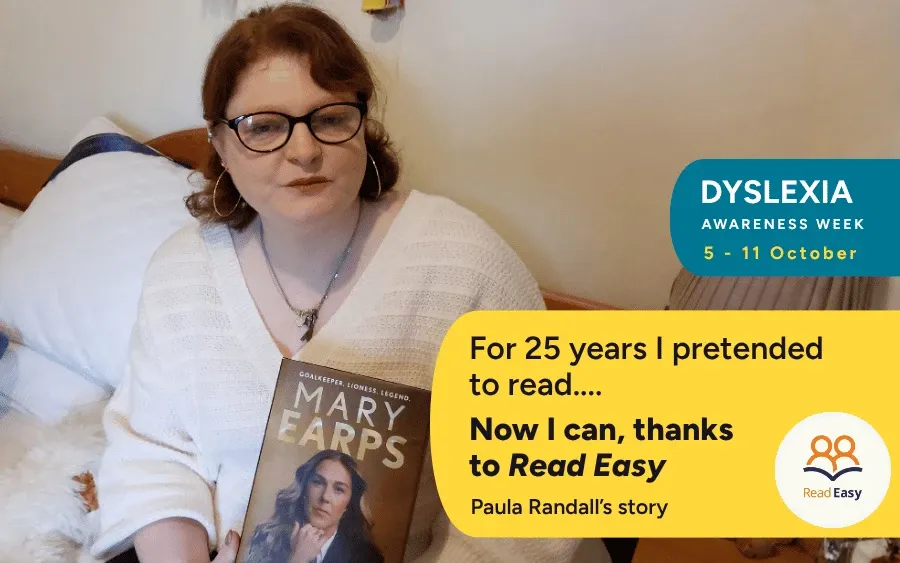
‘For 25 years I pretended to read: Now I can, thanks to Read Easy’
 Imogen Barber
Paula Randall has dyslexia and slipped through the net at school, being diagnosed a matter of weeks before her GCSEs. It was only in her early 40s that she learned to read, with the help of national adult reading charity Read Easy.
Paula is now a Reading Ambassador for the charity and shares her story to inspire and support others.
“I want other people to think: if she can learn to read, I can too. If my story helps even just one person, I’ve done what I needed to do”, she says.
I felt like I was an embarrassment to my family
Recalling her school days, Paula tells me: “I got told I was lazy, disruptive and got put at the back of the class. After a while I didn’t want to be there.”
The emotional toll of being misjudged by teachers was profound. “I felt like I was an embarrassment to my family, that I wasn’t worth anything”, Paula says.
It also meant that any support came far too late for her exams.
“I went into that hall, I felt sick and just thought, what’s the point”, she explains. “I just literally wrote my name, date of birth on the exam paper. Basically I just didn’t do my exams.”
Finding day-to-day workarounds to avoid reading
To navigate daily tasks, Paula relied on creative workarounds, such as memorising the colour-coding system and aisle locations of supermarket items.
She often hid her dyslexia and felt a sense of shame that she was unable to read. Yet despite these challenges, Paula found innovative ways to adapt.
Some employers were aware of her dyslexia and were very understanding. In her first job as a pharmacy assistant, a supportive manager provided photocopied planograms of the store layout and highlighted where the top sellers were, so Paula could have time to memorise each item and work out everything else around that.
She soon found she was able to recognise medicines mentioned in doctors’ handwriting – in some cases better than some of her colleagues.
Transforming her relationship with reading
Aged 42, Paula was encouraged by her husband to reach out for reading support after watching a documentary on TV.
Learning for just 30 minutes a week with her Read Easy coach after work transformed Paula’s relationship with reading.
Although it still takes her some time to get through books, she enjoys reading about fashion as well as autobiographies. Most recently she’s read All In: Football, Life and Learning to be Unapologetically Me, by England goalkeeper Mary Earps.
Being able to read has also had a huge impact on her daily life – including things like being able to read a menu.
“I’m happy now to go out and order what I want on the menu. Whereas before it would be, ‘Oh, I’ve already eaten. I’ve had a big lunch. Oh, I’ll have a bowl of chips. That’s all I want’.…I would just be bluffing it”, Paula tells me.
Supporting dyslexia in the workplace
Everyone’s experience of dyslexia is different, but Paula emphasises that simple accommodations like using voice notes and open communication between employers and team members can make all the difference.
In her current role working in a kitchen, for example, she has developed a short-hand for taking orders and has worked with colleagues so they can understand this.
Her message to employers and colleagues on how to approach workplace support is clear:
“Sit down with the employee, ask them what they can and can’t do, and what the employer can do to help them – it’s got to work two ways. The employer has to give, and the employee has to give.”
“…if you see somebody struggling, don’t judge. There’s a reason why that person is struggling.”
She speaks candidly about the wider public misconceptions that can still exist around dyslexia. “I don’t suffer from dyslexia. I suffer from ignorant people”, she says. “I’m actually proud to say I have it now. I don’t need to hide.”
A message for anyone struggling
Paula’s journey is proof that it is never too late to learn to read.
“When I started, I thought, ‘Am I too old?…. But after a while, it was like, I don’t need to be nervous now. I’ve got this. I can do this”, she says.
I ask her what her advice would be to others who might be in a similar boat.
“Google Read Easy. Read or listen to what I’ve gone through”, she says.
“And yes, you can do it. Don’t let anybody put you down. You’ve had enough of that in your childhood, even some of us in late adulthood.
Anybody can learn to read. Please reach out to Read Easy UK .”
To find out more about reading support, or if you are interested in becoming a volunteer Reading Coach visit: https://readeasy.org.uk/
You can also listen to Paula’s story on That’s TV Hampshire here
And on ITVX here