


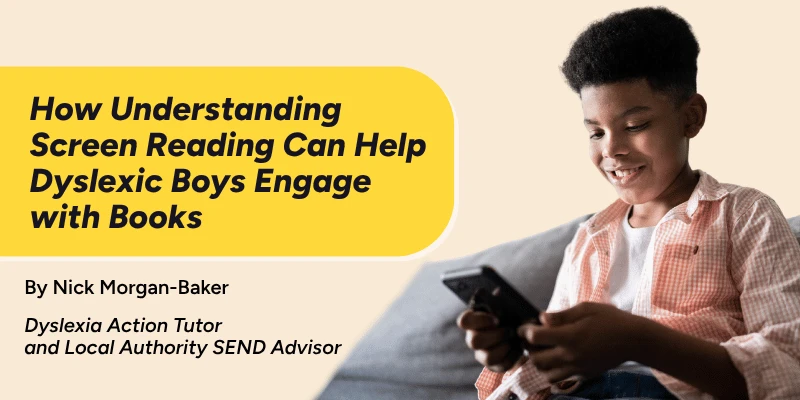
How Understanding Screen Reading Can Help Dyslexic Boys Engage with Books
 Imogen Barber
Screen reading is often thought to be the reason for shorter attention spans and poorer reading skills in children and teens.
Yet, while print reading is associated with deeper comprehension than screen reading in many contexts, its superiority over screen reading is not absolute. Nick Morgan-Baker argues that we need to meet young readers where they are and that digital content can be an important bridge to print reading for some individuals, especially boys who have dyslexia or who are reluctant readers.
By blending digital and print media in authentic reading projects, classrooms can foster what Maryanne Wolf calls “bi-literate brains“, equipping students to navigate deep analogue meaning accessed through print, alongside fast digital skim reading.
 “Comprehension processes grow when young readers leave the surface layers of text to explore the wondrous terrain that lies beneath it.”
Maryanne Wolf, Proust and the Squid.
An increasing number of teens and pre-teens are turning to screen media over printed books. By “screen media” we mean both reading short-form digital content (social media, in-game messages, WhatsApp, etc.) as well as long-form (e-comics, blogs, wikis, e-books, longer news articles).
Not all children with dyslexia are reluctant print readers. That said, for many, the pull towards digital content is significant. Walls of text are replaced by punchy hooks and short captions, supported by engaging visual and audio content, easing the cognitive friction around reading.
But is screen reading just ‘fast food’ for thought?
The answer is no, but it’s complicated.
To explore the relationship between reading in print and reading on screens, in this article we’ll be looking at both neuroscience (exploring the work of Maryanne Wolf) and educational research, but imagining this through the perspective of Zayan, a fictional ten-year-old boy who is dyslexic, a reluctant reader and someone who experiences visual difficulties.
Why focus on boys?
What we will cover applies to both genders, but it seems pertinent to examine this through Zayan’s eyes, given what research suggests about boys’ disengagement from reading. According to a 2026 National Literacy Trust report looking at teenage reading habits, fewer than one in 10 boys aged 14 – 16 say they read daily for pleasure, while boys are also less likely than girls to read in their spare time.
Reading digitally, does, however, feature prominently in qualitative feedback from boys with dyslexia, and in other sources we will discuss later.
If we were to ask Zayan if screen reading is a quick fix to paper print, he’ll say, “My mobile makes words real. In my games I see, I feel: books do nothing and take too much time.”
Digital native in a print world
Ten-year-old Zayan lives with his mum and 13-year-old sister, Inaya, in an English seaside town. Curious and independent, he follows his interests wherever they take him. His video games, for example, lead him to both magazines and related online content.
Generally, however, print reading tires him, so wherever possible he chooses the screen. Yet that doesn’t mean he’s completely closed off to literature. Harry Potter, for example, captures him through films, podcasts, fan fiction, YouTube and Stephen Fry’s audiobooks.
His experience of engaging with books for pleasure is channelled mostly through interaction with a reader. One Saturday, for example, Inaya borrows The Deathly Hallows from the library. Later she reads aloud while Zayan sits on the floor beside her. He leans forward, fixed on every word. Then he interrupts. He predicts the next twist. Inaya disagrees. They argue playfully while the story races ahead.
Like so many children who struggle with reading, Zayan receives free school meals. Few books enter his home; no single title belongs to him. Yet stories still arrive. He listens to podcasts about dragons, giants, and wizards. While MuggleCast plays, Inaya points to interesting words in the scrolling transcript. Spoken words and moving text travel together across the screen.
At school, however, Zayan lags three years behind age expectations in English reading comprehension. Mrs G, the SENCO, worries. An Educational Psychologist has identified dyslexia. As the curriculum shifts from learning to read towards reading to learn, Zayan still works hard to decode words on a page.
Zayan reads constantly, but not in the way school expects. He is a digital native living in a print world. Screen text welcomes him. He swipes, scrolls, taps, searches, filters, and moves on. His eyes hunt key words. He gathers what he needs and leaves the rest behind.
Print asks something different. A page does not scroll. A paragraph does not refresh. A book waits. To make sense, Zayan must slow down. He tracks each line, holds details in mind, returns to earlier pages, and builds understanding piece by piece. He fidgets. He stalls. The quicker he reads, the more details slip away. The slower he reads, the more distant the text feels.
Faced with a dense page, he often pauses and wonders whether he has understood the writer correctly. In tests, time slips away while he rereads difficult sentences. Questions remain unanswered. Yet when teachers discuss ideas, worlds, characters, and technology used in the learning, Zayan contributes eagerly. He explains complex concepts with confidence. The knowledge is there. The difficulty appears when school asks him to pin those ideas onto a printed page.
Zayan wants to read more deeply, contemplating, like Dumbledore, ways out of a magical conundrum. Yet print blocks the path.
Does screen reading erode deeper comprehension?
Whether reading print makes comprehension stronger depends on the reader, their reading conditions and their socioeconomic status. How well Zayan comprehends depends on why he reads, what he reads, how long he reads, and how the text is structured.
Research shows that digital formats improve comprehension compared to print in free reading contexts and where interactive functions are used, but they reduce understanding in explanatory text, under time limits and at a higher education phase. Under other conditions, reading comprehension remains unchanged.
These mixed effects form part of a broader reading paradox, where moderating variables, such as text characteristics, complicate how and why screen reading impacts our understanding.
Effects may also differ when dyslexia is present. Reading on a smaller device providing fewer words per line has been found to benefit comprehension in dyslexic students when it accompanies low visual attention spans. However, studies looking at broader student populations show reading comprehension is lower on mobile phones when considerable scrolling is required, compared to print and even other devices, such as tablets.
For dyslexic readers like Zayan, print represents a conundrum. During timed assessments, or when unfamiliar texts demand too much focus at once, Zayan loses track of meaning. Zayan finds reading over 1,000 words difficult on his own, ruling out medium and long texts like books even with pictures. So short and fast digital reading becomes Zayan’s literacy turf, but rapid reading doesn’t give him the time to recognise and check ideas, predict what comes next in the text, linking new detail to what he’s already read, building mental models in his reading circuit.
Paper print does give the time, plenty of time, driving better comprehension by strengthening neural reading circuits by text length, reading task, the reader’s age and reading purpose. Yet it is difficult for a dyslexic reader like Zayan to access.
This tension lies at the heart of what cognitive neuroscientist Maryanne Wolf calls the challenge of building a “bi-literate brain.” Wolf’s research demonstrates that the brain’s reading circuit is highly plastic and reconfigures itself based on the medium we use. While slow, linear print nurtures the critical capacity for “deep reading“, allowing time for critical analysis, empathy, and insight, fast-paced digital environments prioritise rapid processing and scanning.
For Zayan, the goal is not to abandon digital media, but to cultivate a bi-literate neural circuit capable of reading in both print and digital modes.
In digital we blend – the power of “netspeak”
To work out Zayan’s paradoxical reading habits and skills, we need to understand how language differs from literacy. We invented reading and writing as a secondary skill on top of spoken language, evolved through biology and culture as an innate capability. Language animates Zayan’s natural instincts. Literacy, as a machine, needs a user guide.
Most writers fix their ideas in print, nailing concepts to knowledge existing already in the minds of their readers. When they write without the reader in mind, they often strip away the active doing of a sentence, turning verbs into heavy, abstract things (nominalisations).
Take, for example, when a teacher says, “Water evaporates, forms clouds, and then falls as rain.” A textbook may instead state, “Evaporation, condensation and precipitation form the water cycle.” The actions become abstract nouns ending in -tion. Zayan knows water rises, gathers, and falls. He can picture it. But when the actions hide inside technical words, he must stop, re-read, and reconstruct the meaning.
Reading what linguists Ure and Halliday call language in reflection rather than language in action, Zayan must turn these heavy content words over in long sentences, re-reading in slow cycles to extract purposeful ideas. He misunderstands print reading and, most likely, he stumbles on these abstract words.
Spoken language, however, interacts with the world, flowing verbally through grammar: short, fast, active, and transitory. With fewer content words but more grammatical words, dyslexic Zayan holds aces when it comes to speaking and listening skills. We all speak language in action, and Zayan uses this language brilliantly to connect with people and share ideas, but he can’t translate those spoken skills to understand paper print for class learning.
When Zayan replies to his mum’s text using audio clips, GIFS, and emojis, he effortlessly blends language in action with language in reflection into a single conversation. For him, screen media isn’t just about reading or typing; it is a hybrid language where written shortcuts, visual cues, and natural speech rhythms fuse together.
Instinctively, he gets her intended meaning; he shows transliteracy: “the ability to read, write and interact across a range of platforms, tools and media from signing and orality through handwriting, print, TV, radio and film, to digital social networks…” Zayan may not have yet extended his transliteracy beyond the digital world, but it is still significant that he already blends different digital media to make meaning.
Through this digital ‘netspeak‘ (sometimes referred to as snippet literacy), Zayan fluidly steers a whole new way of making meaning, expressing emotion, and sharing ideas in the digital realm.
Rather than viewing his reading challenges in isolation, teachers can leverage this digital strength. By designing reading projects as active, interactive conversations, we can bridge the gap between spoken fluency and print literacy.
Imagine if Miss Z, Zayan’s teaching assistant, places a tablet beside a printed water cycle diagram, with three key words on a sticky note: evaporate, condensate, precipitate (now making use of language in action.)
Zayan then taps the dynamic screen image, watching water evaporate, form clouds, and fall as rain. Afterwards, he picks up his pencil, writing key words directly onto the paper handout alongside the screen. He ends by reading cloze (key word gaps) text, filling blanks first from multiple choices, then from memory. Cloze reading requires him to use language in reflection.
By facilitating, not teaching, this reading, Miss Z and Zayan have blended language in action and language in reflection. They have also applied a form of transliteracy that intentionally leverages the strengths of both print and digital mediums, balancing deep analogue comprehension with efficient digital skimming.
Kayakers and scuba divers
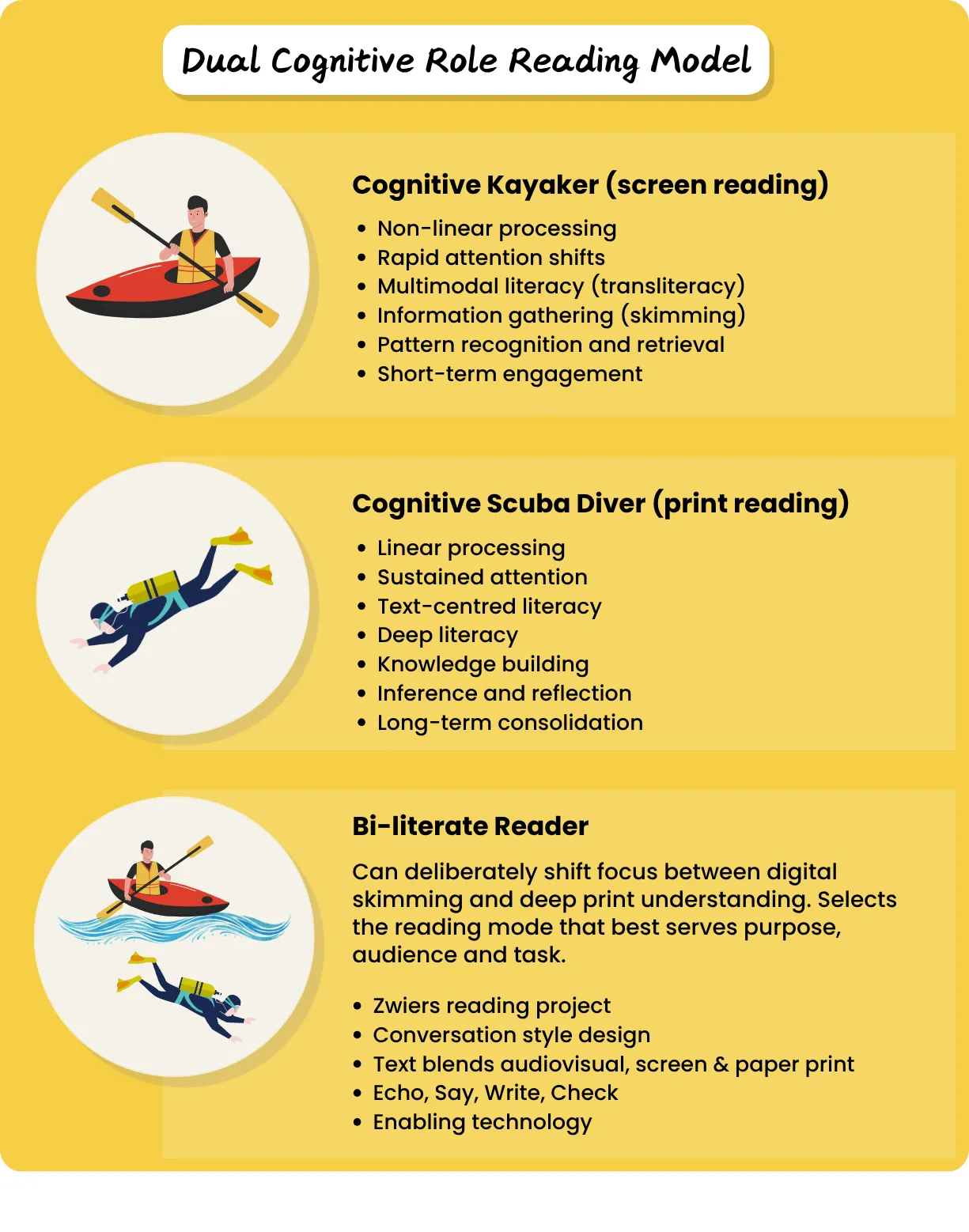
A water sports analogy helps explain how our cognitive styles adapt to the distinct language forms and meanings realised by print and screen media. We can think of this as a dual cognitive role reading model.
Readers like Zayan slip over text. We might call them cognitive kayakers. They skim the information surface, navigating non-linear streams. Zayan reacts dynamically; he decides rapidly based on the diverse information he’s scanned.
Readers like Inaya, on the other hand, have become cognitive scuba divers. They can go deep into paper print, they can submerge into sustained, linear text, whether screen- or print-based and build deep, reflective knowledge structures that are demanded by the curriculum.
What we need to get to is a form of “inclusive transliteracy”. This means Zayan can skim a Harry Potter wiki on his phone, then settle into a library copy of Order of the Phoenix without losing track of the story, giving him the fluency to code-switch without excluding digital media.
A Zwiers reading project
Developed by Stanford researcher, Dr Jeff Zwiers, a Zwiers reading project builds critical thinking in young readers by turning reading into an active, collaborative investigation. Originally designed for English Language Learners (ELL), this reading-to-learn approach can also support dyslexic readers.
Teachers help readers talk with partners in small groups, solving puzzles in the text, making things clear. By merging views and facts, they jointly explore ideas using active language, acting as critical friends in a conversation; what Zwiers defines as authentic reading. Conversing across formats, they talk through pictures, sounds and words as one language of net- and print-speak.
Some specialist teacher qualifications specifically provide training for this type of reading activity design, including the Dyslexia Action Diploma in Specialist Teaching in Literacy Related Difficulties (DIST).
So how might we activate Zayan’s dual cognitive reading model through a Zwiers reading project? Let’s start by giving Zayan a role. Placing readers at the centre of the task builds confidence and makes reading purposeful.
Activating the dual cognitive role model
Zayan will be Harry Potter, who takes the stand in the courtroom on trial for using underage magic to scare away dementors in The Order of the Phoenix. Miss Z will act as his reading buddy and will activate his background knowledge in three reading stages.
1. Before reading (kayaking):
Short digital texts, audio summaries, and visual maps build context through language in interaction while predicting vocabulary and ideas.
Zayan jumps to this task when Miss Z uses a tablet displaying a short audio-visual recap of the Ministry of Magic alongside a printed extract of Harry’s trial before Cornelius Fudge, Minister of Magic. This is in large font with double-spacing and Zayan uses his aqua transparent colour overlay, placed over the black print on white paper.
Miss Z asks closed questions like “What kind of place is the Ministry?” Writing key words frames main ideas and this helps Zayan, so Miss Z gives Zayan these words on a card: disciplinary, cleared, and verdict. This is an anticipation guide giving Zayan key vocabulary before he starts reading.
Visuals for each key word help define what they mean; for instance, disciplinary is defined as a football referee showing a footballer a red card for breaking a rule. He taps the words into his tablet, and a computer voice reads back ‘disciplinary’.
Miss Z asks more closed questions: “Will Harry get a fair trial?” Zayan answers, “No.” “Why?” “Because…” Zayan replies rapidly.
2. During reading (transliteracy):
Zayan flounders with a paragraph describing Fudge as the judge. Zayan says the words don’t mean anything; they don’t come to life. Miss Z uses Think Pair Share, a collaborative strategy that helps Zayan use his prior knowledge when print reading.
He speaks out his ideas; “Fudge is not nice”. Miss Z counters that he is stern, meaning strict, but this doesn’t make Fudge bad. Miss Z asks explicit and implicit questions. She’s cut a version of the paper text into four chunks, right through sentences. Zayan orders the story correctly.
Zayan interacts with the text – it lives. By typing Padlet notes on his tablet that Miss Z has on her screen, they work together, using the same digital tool, posting comments as notes alongside print and commenting verbally too. Zayan’s happy he understands the paragraph by inferring what he already knows. Together they handwrite action verbs: spearheaded, prosecuted, interrogated.
3. After reading (scuba diving):
Miss Z opens a graphic organiser on her tablet, a thinking map and shows Zayan how strange and unlikely ideas (train of thought) relate. Through structured dialogue between them, they follow the stages: context, problem, solution, outcome.
Zayan holds a fact point of view (Harry, who casts a spell, Expecto Patronum, to save Dudley, his unkind cousin) while Miss Z takes an opinion and authority role as Cornelius Fudge. Both actors discuss each stage, analysing the text, notes and visuals across their print and screen formats. They embody thought as active cognition.
More than just ‘fast food’ for thought
Teachers support Zayan when they use physical books purposefully, building what Wolf would refer to as his deep-reading circuitry, strengthening his time to think about the text. At the same time, by teaching him explicit cognitive strategies, Zayan deliberately slows down when he analyses digital texts, diving through layers of meaning: linking ideas, learning new facts.
Channelling our efforts into curriculum design eases Zayan, and dyslexic young boys like him, into class reading projects.
When we blend spoken dialogue with print and screen tasks into a reading project, we achieve far more than simple literacy. We exploit Zayan’s natural transliteracy, he crosses between print and screens, he isn’t just decoding; he is experiencing the meaning twice, bridging two worlds.
As Zayan matures, this approach builds a flexible reading brain. It may not be without challenge, but he navigates difficult and different print environments with greater ease, kayaking the surface speed of modern information when needed, and diving the depths required for deep, critical thought.
Key takeaways
| 1. Build the runway with digital media: Use short audio summaries, snippets from podcasts, and visual maps to spark interest and provide background knowledge before opening the book. (Tip: AI tools can assist teachers by quickly generating these scaffolding materials).
2. Leverage language into literacy: Start with active, spoken dialogue before introducing heavy “language in reflection” (like nominalised textbook prose) and then blend the two. 3. Encourage balanced digital and print reading habits: One caveat is to make dyslexic teenage boys aware of the problems around short-form video reels. When captions are presented, we might count skimming the captions as a reading habit, but emerging research suggests these types of videos can be particularly damaging to working memory and executive function. 4. Turn reading into a conversation: Use shared frameworks between learners and the teacher (such as Zwiers reading projects) that tap into the interactive, conversational flow that dyslexic boys and other reluctant readers are comfortable with. 5. Follow interests and make reading purposeful: Harness role-play, drama, and opposing viewpoints to give learners an active stake in the narrative. 6. Blend digital and print simultaneously: Pair dynamic screen elements (like video animations or Padlet notes) directly alongside paper text and physical note-taking. 7. Continue decoding support (learning to read): Continue using line tracing, colour overlays, text masking, and cumulative, structured multisensory strategies, addressing both phonics and meaning. 8. Develop deeper comprehension (reading to learn): Strengthen neural reading circuits by balancing fast, surface-level skimming (kayaking) with slower, sustained focus (scuba diving) to build high-fidelity understanding of text, turning facts into knowledge. |
About Nick Morgan-Baker
 Nick Morgan-Baker is a tutor for Dyslexia Action and also works for a Local Authority as a SEND advisor. Prior to this he was a teacher for over twenty five years.
His teaching specialism became SEND in further education at Key Stage 4 and Key Stage 5. He qualified as a specialist teacher and assessor in 2005. Currently he tutors on modules in the Diploma in Specialist Teaching (DIST).