


How dyslexia impacts maths
 Lucy Howes
Some (but not all) dyslexic children struggle with maths, and we should accommodate their specific needs in our teaching approach, Kate Sutton explains.
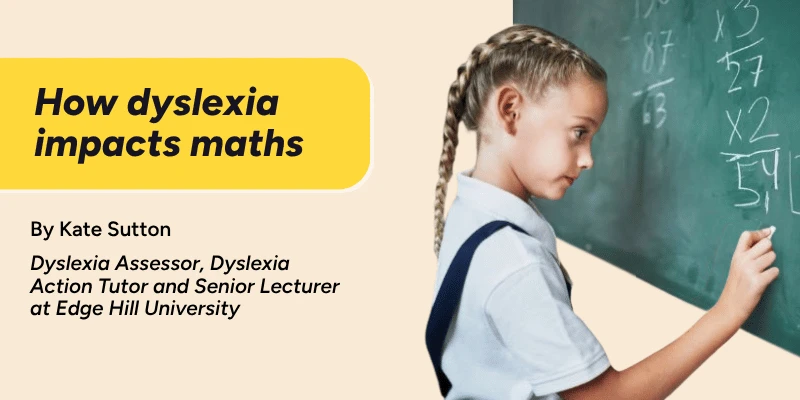
While dyslexia affects each learner differently, it can significantly challenge a pupil’s mathematical confidence. However, dyslexic thinking is also associated with creativity and lateral thinking, key to STEM fields. This underscores the need for better early support from educators to help all students achieve their full mathematical potential.
This article originally appeared in SEN Magazine and is available here.
When we talk about dyslexia, we often mean difficulties with reading, writing, and spelling. These challenges are well recognised, but what’s less widely understood is that dyslexia can also affect a child’s experience of maths. As a (dyslexic) specialist in dyslexia and dyscalculia, people often assume that I am naturally confident in maths, but in reality it was always a significant challenge for me. Today, I find myself assessing individuals for mathematical learning difficulties and tutoring learners who struggle with maths – something that surprises those who have known me since childhood.
I still do not describe myself as someone who is naturally good at maths, but I have learned to succeed through opportunity and practice. A real breakthrough came when I had the chance to explore alternative ways of approaching numerical understanding, methods that I’ve explored further as I completed my training. My experience highlights something important: confidence in maths is not fixed. It can be developed at any stage of life, given the right support and mindset.
Dyslexia and maths
For many children, maths is already a challenging subject. For those with dyslexia, however, the barriers can be more complex than simply understanding numbers. Difficulties with working memory, sequencing, processing speed, mathematical vocabulary, and organising calculations can all influence mathematical performance. Importantly, dyslexia affects every learner differently. Some children may struggle to remember multi-step procedures, while others may find it difficult to process mathematical language or organise their work effectively. Not all children with dyslexia struggle with maths, and indeed some excel in it, but a Spanish study published last year has shown that nearly one in four children with dyslexia also experience concurrent maths difficulties.
The challenges are not always immediately visible. A child who understands a mathematical concept may still struggle to demonstrate their understanding because they lose track of steps, misread information, or become overwhelmed by the amount of information they are required to process at once.
Without appropriate support, these experiences can lead to frustration and disengagement. Maths relies heavily on working memory, which is the system that allows us to temporarily hold and manipulate information while completing a task. In maths, children use working memory when they follow multi-step calculations, and when they remember numbers while carrying out operations. They use it when they solve word problems, or apply mathematical procedures, and when they compare different pieces of information. For example, when solving the sum 37 + 48 mentally, a child must hold the numbers in mind, add the ones, remember the carry digit, and then add the tens. This places significant demands on working memory.
The cycle of fear
The emotional impact of maths difficulties should not be underestimated. Over time, some children develop maths anxiety – a fear of mathematical tasks that can trigger stress, avoidance behaviours, and reduced participation in lessons. This anxiety often becomes another barrier to learning, creating a cycle in which fear of failure limits opportunities for success. Common signs include: avoidance of maths-related activities, feelings of stress before maths lessons or tests, panic or frustration when solving problems, and low confidence in mathematical ability. The signs may include a tendency to give up quickly when faced with challenging questions, or physical symptoms such as increased heart rate, sweating or feeling tense, or an inability to think logically and a drop in communication skills.
Awareness of maths anxiety is essential for anyone supporting children’s learning. Too often, a child who appears distracted, reluctant, or unwilling to participate is labelled as unmotivated or lacking effort. Yet these behaviours may be warning signs. When schools recognise the underlying causes of a child’s difficulties and provide appropriate support, this can help to build confidence, reduce anxiety, and foster a more positive relationship with maths. This is why developing specialist maths-support skills is so important. Teachers and Teaching Assistants who understand how dyslexia can affect mathematical learning are better equipped to create positive and accessible learning experiences. This all begins with recognising that mathematical understanding can be demonstrated in different ways and that learners may require alternative approaches to access the curriculum.
Practical classroom strategies
Visual and multi-sensory teaching
Allowing children to see, touch, discuss, and manipulate mathematical ideas, reduces reliance on memory and abstract thinking alone. The concrete–pictorial–abstract (CPA) approach helps learners build understanding gradually by moving from physical resources to visual representations before introducing symbolic notation. For example, when teaching addition, children might first combine counters to solve a problem, then represent the counters with drawings, and finally record the calculation using numbers and mathematical symbols. By building understanding step by step, the CPA approach helps reduce cognitive demands and supports deeper conceptual learning. This method is particularly beneficial for children with dyslexia and other learning needs because: it reduces cognitive load; it makes mathematical concepts more meaningful; it supports visual and kinaesthetic learning; it helps learners make connections between concrete experiences and abstract symbols; and it improves confidence by building understanding gradually.
Break instructions into manageable steps
Small adjustments can make a significant difference to those who are experiencing challenges with maths. Reducing cognitive overload, providing worked examples, and allowing additional processing time all help learners focus on the maths rather than the barriers they face. These strategies benefit not only children with dyslexia but many other learners as well.
Allow extra processing time
Time pressure is a common feature of many maths classrooms. However, for children with difficulties in processing speed, orthographic processing, or working memory, these demands can be overwhelming. When learners are rushed, they may focus more on keeping up than on understanding the maths itself. Providing additional processing time can help reduce anxiety, improve accuracy, and allow children to demonstrate their true mathematical abilities. In maths, mistakes are not signs of failure—they are valuable learning opportunities that help children develop problem-solving skills and strengthen their understanding. Allowing learners the time to explore, make errors, and reflect on their thinking can lead to greater confidence and long-term mathematical success.
Pre-teach key vocabulary
Difficulties with understanding mathematical vocabulary and language are often one of the most frequently reported difficulties for dyslexic pupils. Maths is rich in specialised vocabulary, and many terms have meanings that differ from everyday usage. Words such as difference, product, or multiple can create confusion if they are not explicitly taught. Pre-teaching key vocabulary, encouraging mathematical discussion, and using concrete examples can help learners develop a deeper understanding of concepts and improve their ability to communicate mathematical thinking.
Assistive tools and specialist interventions
Assistive tools such as dictation software, visual organisers, and calculators (when used appropriately) can reduce unnecessary barriers and allow children to focus on problem-solving and reasoning. Alongside these tools, specialist interventions and targeted support programmes can provide additional opportunities to address specific learning needs and build confidence.
Parent-teacher partnership
Supporting children with dyslexia is not solely the responsibility of schools. It relies on strong and effective partnerships between teachers and parents. Regular communication helps ensure classroom strategies are reinforced at home, while enabling parents to understand how best to support their child’s learning. Most importantly, schools and families should prioritise the development of resilience, confidence, and a growth mindset, rather than focusing exclusively on errors and mistakes. I often hear parents say that they can’t do maths, largely due to negative experiences during their own schooling. However, this perceived lack of ability does not prevent them from playing a vital and meaningful role in their child’s learning. Parent workshops and family learning sessions can help rebuild confidence and provide practical strategies for supporting learning at home. Providing manipulatives for home use, alongside digital apps with virtual manipulatives, can further strengthen children’s understanding by making abstract concepts more concrete and accessible.
Extending dyslexia support beyond literacy
As awareness of dyslexia continues to grow, so too must our understanding of its impact on maths. Children with dyslexia are capable of mathematical success, but they often require teaching approaches that recognise and accommodate their unique learning profiles. From my own personal observation, it is always interesting to note on GCSE results day how many Year 11 students with dyslexia seem to gain a higher grade in GCSE English than in maths. I believe this is, in part, due to other interventions for dyslexia focusing on literacy rather than its wider impact on other curriculum areas. If we invest in the right training to develop specialist mathematical support skills, these barriers can be significantly reduced. For the child who struggles silently with maths every day, that investment can make all the difference, reversing or even preventing that spiral of anxiety.
 Kate Sutton is an assessor for dyslexia and maths-based SpLD, including dyscalculia. She is a member of The Dyslexia Guild and a tutor for Dyslexia Action and Real Training, and she is a senior lecturer at Edge Hill University.
Kate Sutton tutors on Dyslexia Action’s Level 4 Unit in Developing Numeracy Skills in Learners with Dyslexia and Dyscalculia and Real Training’s Dyslexia Professional Report Writing course. She is also a senior lecturer at Edge Hill University.
Dyslexia Action also offer the Level 7 Postgraduate Certificate in Specialist Teaching for Maths Related Difficulties; a longer, more in-depth course that includes intervention planning.